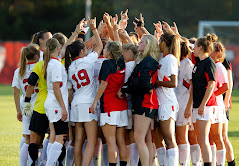
The following is taken from a speech given by Bunny Sandler at the annual conference of the National Association of Collegiate Athletics Administrators (NACWAA) in St. Petersburg, Florida on the 35th anniversary of the passing of Title IX. Sandler provided an historical context to her five-decade career.
Bunny Sandler
The Real Story Behind Title IX
It was the
late 1960’s, the women’s movement was just a few years old and the terms “sex
discrimination” and “sexism” did not exist. There were no newsletters or conferences devoted to women’s
issues. Email was not available to
help women communicate with each other.
Women needed
much higher grades than men to get into a college and grad schools set a limit
on the number of women admitted. Some 21,000 women were denied admission to
state universities in Virginia, but no men. The veterinary school at Cornell University NY admitted just
two women a year, unlike today when 70 – 80% of vet students are women.
Women
applying for faculty jobs routinely heard, “Your qualifications are excellent
but we already have a woman in this department.” Some departments had neither women nor plans to hire
any. Nobody would have hired a
married woman.
Bunny
Sandler felt the discrimination.
As a part time lecturer at the University of Maryland, she applied for a
tenure-track job but was told by a colleague to forget it, because “You come on
too strong for a woman.” She went
home and cried.
Her
then-husband understood. “Are
there any strong men there?” he asked.
“All of them,” she answered.
“It’s not you, its sex discrimination,” he told her.
Eschewing
the nascent women’s movement, Sandler continued to apply for jobs and got two
more rejections, including being told, “You’re not really a professor, just a
housewife who went back to school.” Three times she got on the short list, but
didn’t get the job.
Having been
denied opportunities many times because of her sex, Sandler began to read about
legal issues and sex discrimination.
“I naively thought that since sex discrimination was wrong, there must
be a law against it,” she said.
But the 1963
Equal Pay Act covered women and men, but exempted education. Title VI of the 1964 Civil Rights Act
prohibited discrimination based on race, origin, color and religion, but not
sex. Title VII of the Civil Rights
Act exempted educational activities at schools. And the 14th Amendment to the U.S. Constitution
did not apply to women.
Finally
Sandler found a footnote to a law on federal contracts that prohibited
discrimination based on sex. “Eureka!” she said. She’d found the needle in the haystack of federal
regulations that would support women.
In January
of 1970, she and a small band of women (and a few “men of goodwill”) filed the
first complaint against every college with federal contracts, about 250 of them. “It was
very easy to do,” she recalled, but it went unnoticed except by the Saturday
Review of Literature, which listed it under the heading of “Women’s
Activities.”
Sandler
encouraged other academic women to compile data on the number of women in each
department in their schools, and learned the percentages were dismal. “At the time women received 22% of the
doctorates in psychology, so you’d expect the number of women faculty to be
comparable,” she said. “But in
Harvard University’s graduate school of humanities of sciences, the last time
they’d hired a women was in 1924.”
She advised
faculty women feeling the discrimination to contact their Senators and
Congressmen, and the Secretary of Labor, Health and Welfare, demanding
enforcement of the executive order forbidding discrimination in schools with
federal contracts. Staff members
learned about the new issues, as did their bosses.
Within four
months, many women had filed complaints, and the universities of Michigan and
Harvard had been called on the carpet.
“The U.S. government became directly involved in the investigations
related to sexual discrimination in higher education,” she said. “Pandora’s Box had opened.”
Congresswoman to the
Rescue
Representative
Edith Green (D-Oregon) had long been interested in women and education, and in
fact had proposed an equal pay act eight years before it became law. As chair of the House committee on education,
she introduced a bill requiring gender equity in education, on which her
committee held hearings. Sandler
lined up women to testify about not getting hired - or receiving lower pay, no
benefits or offices – even one who was not paid because her husband worked at
the same school.
“The
American Council on Education was the main player in higher education,” Sandler
recalled. “But the president at
the time declared there was no sexism in higher education – and even if there
was, so what? Their reaction
showed higher education wasn’t watching.”
Few members
of congress were aware of the bill, and they certainly didn’t imagine its later
effect on college athletics. “It
was easy to get data. We had 1200 pages of data on sex discrimination in higher
education,” she recalled.
After
Passage in the House, with the strong support on Rep. Patsy Mink (D-Hawaii),
Title IX went to the Senate where Sen. Birch Bayh (D-IN) finessed it through
with assurances that beauty pageants could still award scholarships “based on
skill” and women would not be allowed to play football. After Mink’s death in 2002, the law
called Title IX was re-named to honor her.
What about Athletics?
Sandler was
involved in a 1974 study that revealed some strong anecdotal evidence that in
the1970’s women in athletics got only a tiny sliver of the pie. For example, the University of Michigan
had a $1.4 million budget for athletics, and none of it went to women’s
programs, Sandler listed these examples:
· Women sold apples at football games
to pay for their uniforms.
· Male athletes flew to contests first
class, while women drove their own cars or rode with coaches.
· In gymnastics, men saved their used
tape for the women’s team.
· Women athletes got negative messages,
including a coach telling an injured player: “Put your foot in the toilet and
keep flushing.”
It was not
secret that men got newer and better uniforms, locker rooms, exclusive use of
an intramural pool at certain times, better-trained coaches, academic credit
for participating in athletic events and exemptions from taking physical
education classes.
Why didn’t alarms go
off about Title IX and athletics?
“Awareness
of sex discrimination was so limited that nobody expected the impact,” Sandler
recalled. “In my 1970 testimony, I
didn’t even mention athletics. A
year later, I mentioned athletics in just one sentence. After it passed in June of 1972, five
or six of us realized that Title IX would cover athletics as well, but we never
considered its effect. I thought
that maybe on Field Day, there would be more activities for girls.”
Representative
Green knew it would have great impact, but discouraged Sandler from enlisting
women to lobby Congress. “She said
nobody should know about the bill or we’d get lots of amendments to it,”
Sandler said. Green wrote the bill
to follow the style of Title VI, with “grand language like the Constitution and
Bill of Rights,” Sandler said, adding sex to the list of prohibitions against
discriminating by race, religion and national origin. Since the NCAA covered only men’s sports at the time, it did
not oppose the bill.
When
President Nixon signed the bill into law, Sandler said, “A new era had begun,
but few knew this would change education and schools forever.
Prior to Title IX (1970) After
Title IX
Women were 4% of law students Women
make up over 47% of law students (2009 – 2010)
Women were 8% of medical students Women
make up 48% of medical students (2009)
Women were 1% to 4% of all other
professional schools Women
make up 39% - 45% of other professional
.jpg)


 Posts
Posts